
A Week in Oslo and an Eclipsing Civility.

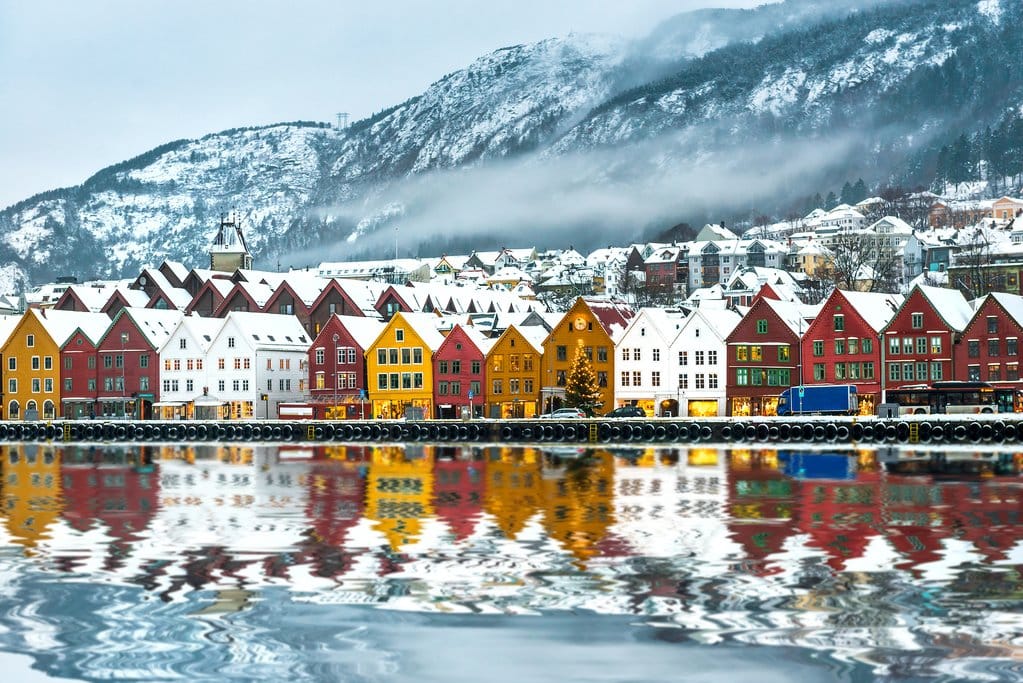
As the plane descended, the city of Oslo revealed itself beneath us, yawning outward with an understated elegance. Its winter light diffused through felted clouds, rendering every colour a subdued hue of porpoise. The tranquillity of this capital was undeniable, yet I came to realise its calm conceals a deeper tension; a chasm of consciousness.
I spent a week in Oslo’s streets and pewter districts. I moved between modernist buildings, exuding geometric fixation, and sauntered between hollow remnants of Lutheran heritage lingering in the architecture. It was during my week in the city, that a realisation dawned upon me, a realisation that secular socialism, as ostensibly triumphant and self-assured as it was in Scandinavia, has created a society of material competency yet a total absence of any spiritual predilection.
Norway is often cited, with a certain reverence, by Western commentators as the fastigium of enlightened social democracy. Its economic prudence, efficient public infrastructure and established welfare provisions are applauded with an almost scriptural devotion in political literature. Yet, as a Muslim observing the city, I found myself questioning what had been sacrificed at the altar to achieve this alleged, immaculate order. Islam teaches that human flourishing requires not just an equitable distribution of resources but an internal orientation towards the truth. A country may run smoothly, but this alone cannot nourish the soul.
On the other hand, Oslo is not without signs of moral persistence. There is a sizeable Muslim presence, one that has grown steadily as immigrants from Pakistan, Somalia and various Arab countries have made the Norwegian capital their home. I visited several mosques during my stay, including those tucked discreetly between apartment blocks and others more visible like the Central Jam-e-Mosque that looks like an ornate Mughal palace, so very out of place and time. There was a warmth there, in those mosques and communities that contrasted sharply with the secular froideur of the broader society. Inside these mosques, I found myself distant from the seclusion of the Scandinavian peninsula, but rather in an unremitting rhythm with the rest of the Muslim world - and not in the swinging-Sufi sense before any of you get ideas - but a communal pulse, the cadence of Quran and the shuffling of feet into neat rows in this universal coevality. Masjids function not only as places of worship but as bastions of a global coexistence rooted in a singular, transcendental purpose.
It was particularly striking to observe how the Pakistani and Arab communities have carved out their own cultural enclaves, preserving tradition. Speaking to some locals I discovered their children go to Norwegian state schools during the week and then weekend madrasas. The contrast between these communities and the secular ethos outside was reminisce of Charles Taylor’s contention in his book, A Secular Age, that modern Western societies operate within what he calls an “immanent frame”, a worldview confined to material, scientific and psychological explanations, devoid of any metaphysical or spiritual reference. The Muslim communities, by contrast, inhabit a world centered around God.
In the city centre, the signs of Norway’s now foundational secularisation were undeniable. Churches stood so quiet they made British cathedrals' meagre masses feel flourishing. Oslo’s public life exuded an air of procedural politeness, a civic calm that hinted at disenchantment above anything else. I began to appreciate, walking those streets, how thoroughly the Norwegian understanding of life has been shaped by postwar socialistic democracy, which offered not only economic reforms but an implicit rejection of the metaphysical via the proposition that human beings could organise 'good' societies without any recourse to the divine.
From the vantage point of Islamic civility, the aforementioned proposition seems at best misguided, and at worst, nefariously naive. Islam doesn't deny the value of welfare, but it teaches that society requires a moral axis around which all considerations and sensibilities revolve. Without the anchoring of divine law, social order risks becoming little more than technocratic logistics, impressive in efficiency yet incapable of addressing the deepest human necessity - purpose. A welfare state can provide for every material need but still leaves the heart unmoored, oscillating between empty luxuries and quiet despair.
The city has achieved a degree of egalitarianism, that many other European nations envy, or at least their more left-leaning constituents do. But there is a sense of expanding hollowness.
A telling moment occurred when speaking with a Norwegian born Pakistani, after Asr in the mosque. He spoke warmly about Norway, he acknowledged, however, a growing weariness amongst some people especially the youth, an unarticulated sense of "something missing". He observed that despite the absence of much fiscal hardship, many Norwegians feel strangely disconnected. His insights reminded me of Surah Ra'd where Allah SWT says "Surely, in the remembrance of Allah do our hearts find comfort." Without that remembrance, no amount of social planning can fill the void he was describing.
I hope you know my reflections are not meant as a condemnation of Norway. It is a place of great captivation, its natural beauty and its people show admirable civility and kindness. Yet, my time in Oslo revealed the limitations of a worldview that has exiled the spiritual from national identity. What is the Norwegian life beyond a set of ephemeral Humanist values and high taxes? What does life or ambition look like for a kid in the largest welfare state in the world? The presence of Muslim communities stand, as always, subtle reminders that human beings remain innately drawn to the divine even when the surrounding culture insists otherwise.
As the plane lifted from the frosted runway, I watched the pale winter light flicker across its waterfronts and fjords, I know that Oslo offers a kind of parable for the modern West. It shows what can be achieved when a society prioritises material wellbeing with singular focus, yet I think it reveals an intangible spiritual cost to each of its subjects. A civilisation can clearly provide comfort without providing much meaning. It can eliminate poverty without cultivating purpose. It can fill the stomach while leaving the soul malnourished.
For Muslims, the lesson is clear. Prosperity and social justice are very noble aims but they must be grounded in a worldview that acknowledges God as the source of all meaning. Without that grounding, the city becomes a well-engineered machine, meritorious in its function, yet incapable of looking beyond itself.
Faithfully, Issa.